Wednesday, March 2, 2011

Cultivating Open-mindedness Through Cognitive Dissonance

Cognitive dissonance is an uncomfortable feeling caused by holding two contradictory ideas simultaneously. 

We have often heard the saying, "Let's agree to disagree".  What does this mean?  To me it means we may not have the same belief system or philosophy, but we respect each other's opinion or approach.  Discussions whereby arguments take place and debates ensue are healthy and can often act as a learning experience.  In Susan Scott's best selling book, Fierce Conversations, she advocates the importance of having open and honest conversations with people.  Such relationships should be cultivated in workplaces.  People shouldn't feel threatened by arguments and debates; they need to treat them as learning opportunities. 

We can learn a lot from our enemies or people who don't uphold our same viewpoint or approach to doing things.  Walkers can teach runners to pace themselves.  Junk food eaters can teach healthy eaters to indulge once in awhile.  Lex Luthor can teach Superman that he can't do all by himself.  But, being open to this approach can be messy.  It is often human nature to get emotional when debating and arguing.  Most people want to minimize conflict and thus steer away from opportunities related to cognitive dissonance. 

Just this week, while on the social networking site, Twitter, I was following a person who was constantly making negative comments about the course management system Moodle.  I got frustrated with him saying bad things about a system I think is fantastic.  In the end, I decided to not follow his tweets anymore.  Was that the right move?  When a person has affection for something, they can often develop a biased toward the object or way of doing something.  In hindsight, I can learn a lot from someone that doesn't hold the same views I do about Moodle.  The saying, "You should keep your friends close, and your enemies even closer", speaks volumes about the importance of being open-minded and willing to listen to other people's views. 

In fact, I am going to activity seek out people on Twitter that uphold differing opinions and points of veiw.  Twitter often gives you suggestions of people to following based on similarities.  I think they should have another category for people to follow based on differences of opinion!

Sunday, February 6, 2011

Cultivating The Hidden Curriculum--Fortitude

Teachers wear many "hats" in the classroom.  As we become more and more comfortable with curriculum, instruction and assesssment, those "hats" start to change and look different.  We start to develop what might be called, "our hidden curriculum".   The hidden curriculum may be thought of as something that is indirectly cultivated by teachers or a school that is not written down or articulated in any book or manual.  Our hidden curriculum is often embedding in our teaching philosophy.  Over the years I have spent a lot of energy ensuring students learn to "never give up", as evidenced in this video clip.


Schools often make it difficult to help students learn to never give up.  One popular and arguably damaging practice related to instilling a "never give up" attitude is the zero policy.  That is to say, teachers will establish due dates, time lines and late policies for assignments and then penalize students when they don't meet these deadlines, which may ultimately lead to giving a score of zero on the assignment.  This assessment practice has grave consequences.  Instead of teaching the student the lesson of responsibility, it often teaches them that giving up is okay.  Douglas Reeves wrote an excellent article about assigning a zero to student work; you can view it here.  What strategies could we adopted to build fortitude in students?

1.  Never Give a Zero-  if students fail to hand in assessments in a timely manner, have them come in at lunch until they finish what you have given them.  If the purpose of the assessment is to gather information about the student to see where they are at and where they need to go, then giving it a zero is counter productive to moving students forward in their learning.
2.  Give assignments that enable students to try more than once- Students need to be able to practice what we teach, learn from their mistakes without fear and punishment, reflect and grow.  The best way to do this is allow them multiple attempts.  E-assessments can afford the opportunity for many attempts at certain types of assignments so that students can try again without overwhelming the teacher with a huge workload.

In the end, teachers should be doing all they can to build success in student's.  As we all know, success builds confidence.  "May the Force be With You"!

Friday, February 4, 2011

It's A Small World

Margaret Mead once said, ""Never doubt that a small group of thoughtful citizens can change the world. Indeed, it's the only thing that ever has."  


With more and more citizens around the world having access to internet, small groups of people are starting to collaborate, share, reflect and learn from each other to change the world.  As educators, we should feel more and more obligated to provided opportunities for our students to connect with others beyond the text in a book.  Instilling international understanding and intercultural awareness is no longer just the social studies teachers job.  It is my belief that global education should permeate through all subjects.  Here is a video clip of how teachers might get started:


The sites I recommend in this video are listed below.


1.  Epals-http://www.epals.com
2.  IEARN- http://media.iearn.org/home
3.  Take It Global- http://www.tigweb.org/
4. Teachers without Borders-http://www.teacherswithoutborders.org/


Here are some more Global Education sites-


5.  The Global School House- http://www.globalschoolnet.org/index.html 


6.  Flat Classroom Project- http://www.flatclassroomproject.org/
 

Thursday, February 3, 2011

Making Learning Fun

In many places around the world, the pressure of doing well on standardized tests has taken the fun out of education.  Yet, making something fun can often motive people to work harder, as evidenced in this video clip.


One of my favorite books as a beginning teacher was The Laughing Classroom, by Dianne Loomans and Karen Kolberg.  In their book they advocate several quick and easy strategies to keep the fun in learning and motivate students to work hard.

Over the years, I have also come up with my own games or strategies that I have adapted from television shows.  Here are some of my favorite strategies to keep learning fun;

1.  The homework game- near the end of class I would ask for 5 volunteers to play a contest.   The contests would vary depending on the day: rock-paper-scissors, shoot the ball of paper into the garbage can, bowling, name that tune, etc.  If the student beat me at the contest, I would take one question off their homework assignment.

2. The Mystery Bag- I used this strategy at the start of class, as a set induction technique.  In an old pillow case, students would have to stick their hand into the pillow case and try and guess the item without looking.  If they were correct I would bring the item out of the bag.  Items in the bag would be related to the topic of lesson.  Once all items were identified, we would discuss how these items were related to the lesson.

3. Jeopardy Auction Game-before a major quiz or test, we would play an electronic game of jeopardy (see this site to build your game).  Students can earn monopoly money for each correct answer.  Then, close to the end of class, I would have small prizes that could be purchased with then fake money they won during the game.

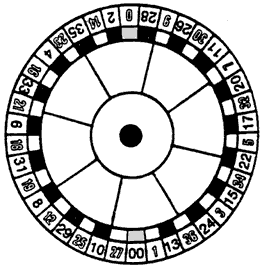
4. Spin the Wheel Review-I build a spinning roulette wheel like the one in the picture.  Then I place review questions and small prizes on the wheel.  I ask for students to come up and stand by the wheel.   I give it a spin, when the wheel stops, students answer the question that is pointing to them, if they are correct, they get the small prize.  There is an option to ask for help from the audience but then they must share the small prize.

Tuesday, January 18, 2011

Useful Science Apps from Apple

We have a mobile Ipad cart and several middle school students bring their own 4th Generation Ipod Touches and Iphones to school, which affords me a lot of freedom when it comes to integrating technology into my middle school science labs.  With such great access to apple products, I have spent some time this year investigating useful science apps for labs.   Some apps have been invaluable, as they are much cheaper than purchasing a science instrument from a supply store all on it's own.  In addition, students will often go home and use the same apps we use in school at home on their own personal devices, thus extending their learning time.  Science fair projects are much easier now that we have apps.  Here are a few of the science apps I have used:


1.  Tinkerbox (free)- this physics type game allows you to build complex machines from simple parts.  It is very similar to an old game called "The Incredible Machine".  You learn about simple machines, mechanical engineering principles and problem solving.  After some free play time, I will usually give the students some guiding questions to help them with steer them in certain directions regarding their learning.


2.  Instant Heart Rate Monitor ($0.99)-  In middle school science we investigate many questions regarding what might affect our heart rate.  Students often come up with some very interesting questions which require more precise measurement than your feeling your pulse with your fingers on your hand.  For example, one student wanted to test whether chewing gum affected our heart rate.  With an Ipod Touch 4th Generation or an Iphone, you can put your finger over the camera and the device will record your pulse rate.


3.  Decibel Reader ($1.99)- Our school does have more sophisticated and accurate decibel reader, but this one works fine for the simple sound experiments we do in middle school science.  The more accurate one is used mostly by the high school physics classes.  Again, I love the portability of this device.  Students that are dong experiments at home can download this app on their own personal devices at home and continue to experiment, which many do!!

Thursday, December 9, 2010

Professional Learning and Twitter

I recently was reading the December issue on Educational Leadership, December 2010 | Volume 68 | Number 4 
  (Pages 74-93 ) on "What Makes a Great Teacher?".  In this article the authors describe several characteristics of a great teacher.  One quality listed that resonated most with me was the willingness to grow and be reflective.  However, it is this important quality that often gets put on the "back burner" when teachers are busy accomplishing the multitude of task they need to ensure their day is running smoothly.  When faced with the question of whether I should finish marking student reports or read an informative and thought provoking educational blog, most would finish the reports because it is more utilitarian.  How can busy educators grow professionally, stay connected and learn with little time?  My answer came in the form of Twitter.  Although I am a newbie to Twitter, with only a few weeks of usage.  I have learnt more in these few weeks than I have through several years of school professional development.  What makes Twitter so effective as a Professional learning tool?

1.  140 characters-  twitter only allows you to type in 140 characters, which enables people to be concise regarding what they need to say or share.  If someone wants to dig deeper into the topic, most tweets offer a link to an article, blog or video.
2.  Choice- you can follow and search for different "topic/chats" (ex. Elementary Chat, Science Chat, Social Studies Chat)  and you can follow people who tweet based on similar interests all around the world or even local.
3.  Synchronous and Asynchronous Functionality-  twitter can can as an instant tool for immediate discussion or you can post a problem or question and end up checking the result later.
4.  A large Scope of Topics-  Twitter is a smorgasbord of topics whether it be related to education or something else.  You can use the hashtag symbol followed by the topic "#topic" (ex. #elementary, #science, #caned, #assessment) to find people tweeting about and sharing information.

Here is a screen cast on  my experiences using twitter:

Saturday, December 4, 2010

Professional Development On a New Level

Traditionally, professional development for teachers in most schools can be costly and sometimes frustrating.  Often schools only provided partial funding for teachers to attend a conference that requires travel, food and hotel costs.  Or, we fly several hours to attend a conference only to be disappointed about the learning that occurred.  Have you considered EdCamp?

EdCamp is a growing phenomenon in the field of education.  It is very much like an an unconference.  As definded on the Edcamp wiki, "Edcamp is free (or very cheap), democratic, participant-driven professional development for teachers."  Here is a video clip with a brief explanation of Edcamps:


Here is a blog that lists many Edcamps. http://www.cybraryman.com/edcamp.html